
 English
Views: 0 Author: Site Editor Publish Time: 2026-03-13 Origin: Site


Woodworking has undergone a profound transformation over the last decade, evolving from a traditional craft rooted in manual expertise to a high-tech discipline defined by digital precision and geometric complexity. As architects and interior designers push the boundaries of organic forms and parametric structures, the limitations of conventional machinery have become increasingly apparent. To bridge the gap between imaginative 3D concepts and physical reality, the industry has turned to the 5 Axis CNC Machining Center. This advanced technology allows for the manipulation of timber across five different planes simultaneously, unlocking a level of intricacy in wood design that was previously considered impossible or prohibitively expensive. From high-end furniture and intricate musical instruments to massive structural glulam beams, the 5-axis approach is redefining the vocabulary of modern timber craftsmanship.
For centuries, woodworking was defined by the straight line and the 90-degree angle. Even with the advent of 3-axis CNC machines, the ability to create complex, interlocking joints on curved surfaces remained a challenge. The introduction of the 5 Axis CNC Machining Center has effectively removed these geometric shackles, allowing for "free-form" joinery that follows the natural flow of the design.
Traditional joinery like the mortise and tenon or the dovetail is usually restricted to linear planes. However, in modern parametric architecture—where hundreds of unique wooden components must meet at varying angles—standard joints fail. A 5 Axis CNC Machining Center can execute "angled joinery" with surgical precision. By tilting the spindle to the exact degree required by the CAD model, the machine can cut pockets, slots, and holes in a single pass that would otherwise require complex manual setups. This capability is essential for the assembly of complex timber gridshells or modern art installations where no two pieces are identical.
One of the most significant advantages of a 5-axis system in woodworking is the ability to machine undercuts. In traditional 3-axis routing, the tool is always vertical, making it impossible to reach beneath a surface or inside a hollowed-out organic shape. In high-end furniture design, such as the backrest of a sculpted chair or the underside of a curved table, these undercuts provide both aesthetic depth and structural lightness. The 5 Axis CNC Machining Center can "reach around" the workpiece, carving out negative space and internal hollows that give timber products a refined, hand-carved appearance while maintaining industrial-level consistency and speed.
Wood is an organic, anisotropic material, meaning its properties change depending on the direction of the grain. Achieving a smooth, high-quality finish on complex 3D wood surfaces requires a deep understanding of how the tool interacts with these fibers. The 5 Axis CNC Machining Center provides the technical control necessary to master these variables.
One of the biggest challenges in wood machining is "tear-out"—where the cutting tool lifts and splinters the wood fibers instead of shearing them cleanly. This usually happens when a tool moves against the grain. In a 3-axis setup, the tool direction is fixed. However, an advanced 5 Axis CNC Machining Center can rotate the tool (or the table) to ensure that the cutting edge is always approaching the grain at the optimal angle. This "grain-following" capability ensures a silk-smooth surface on even the most difficult hardwoods like walnut, oak, or exotic tropical species, significantly reducing the time spent on manual sanding and refining.
Timber requires high peripheral speeds for clean cutting. Modern 5 Axis CNC Machining Center units are equipped with high-performance spindles, often reaching 24,000 RPM, which allow for a high "chip load" while maintaining a light touch. This high speed, combined with the machine's ability to maintain a constant perpendicularity to the surface, prevents the wood from scorching or splintering. For intricate decorative panels or musical instrument components (like guitar bodies or violin scrolls), this level of control is the difference between a masterpiece and a ruined piece of premium lumber.
Beyond solid timber, the 5-axis machine is also the tool of choice for engineered materials like MDF, plywood, and Cross Laminated Timber (CLT). While these materials are more uniform than solid wood, they are prone to "chipping" on the edges. The 5 Axis CNC Machining Center allows for "climb milling" or "conventional milling" strategies to be swapped in real-time as the tool traverses the part, ensuring that every edge is crisp and every pocket is clean, regardless of the material's internal composition.
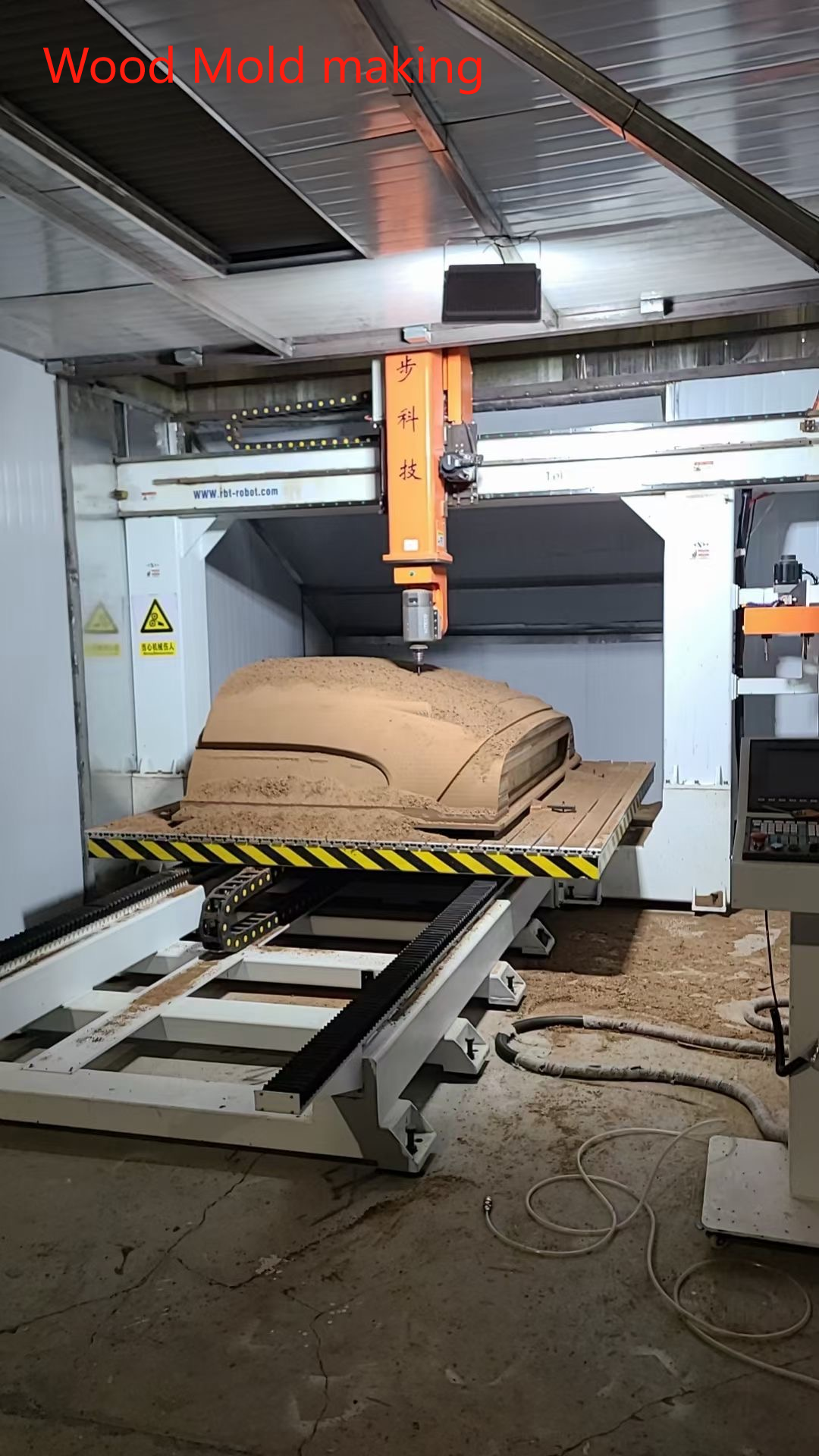
The modern consumer demands uniqueness, but the market demands efficiency. The 5 Axis CNC Machining Center is the ultimate tool for "Mass Customization," allowing a factory to produce a wide variety of complex designs without the need for specialized tooling or long changeover times.
In a traditional workshop, a designer chair leg might pass through four or five different machines: a band saw, a sander, a drill press, and a manual router. Each move between machines introduces the risk of misalignment. A 5 Axis CNC Machining Center handles the entire process in one setup. The raw timber block is clamped once, and the machine performs everything from the initial roughing to the final drilling of mounting holes and the carving of decorative details. This "one-and-done" approach not only guarantees dimensional accuracy but also slashes lead times, allowing manufacturers to move from a digital design to a finished prototype in hours rather than days.
While "nesting" is common in 2D sheet processing, a 5 Axis CNC Machining Center brings this efficiency to 3D parts. By optimizing the placement of multiple complex components on a single large timber slab, the machine minimizes waste. This is particularly important when working with expensive hardwoods. The 5-axis head can navigate tightly packed parts, cutting at angles that a 3-axis head could never reach, ensuring the maximum possible yield from every board.
Before the 5-axis era, creating complex curves in wood often required custom-made "form tools" or specialized jigs. These are expensive to make and take up valuable warehouse space. A 5 Axis CNC Machining Center uses standard ball-nose or flat-end mill bits to create any shape imaginable through "interpolation." This means the factory can maintain a smaller inventory of tools while simultaneously expanding its design capabilities. The flexibility of the 5-axis head serves as a "universal jig," able to adapt to new designs instantly by simply loading a new G-code file.
Working with timber presents challenges that are not found in the world of plastics or composites. From moisture-induced movement to the sheer volume of waste material, a 5 Axis CNC Machining Center must be specifically configured to handle the peculiarities of the wood industry.
Timber is "alive"; it moves with changes in humidity and temperature. Even a perfectly flat board can develop a slight bow after being clamped. A high-quality 5 Axis CNC Machining Center often incorporates probing technology. Before the machining begins, the tool head uses a touch probe to "map" the actual surface of the wood. The machine's controller then automatically adjusts the 3D tool path to match the board's real-world shape. This ensures that features like engravings or inlay pockets are always at a consistent depth, even if the timber itself is slightly warped.
Wood machining produces a massive amount of chips and fine dust. This dust is not just a nuisance; it can clog mechanical components and pose a fire hazard. A specialized 5 Axis CNC Machining Center for timber is designed with high-volume, multi-point dust extraction systems. These systems often feature "shrouds" that move with the 5-axis head, ensuring that the suction is always at the point of the cut. This keeps the working area clean, prevents the tool from "re-cutting" wood chips (which generates friction heat), and protects the health of the operators.
To take full advantage of a 5-axis machine, the tool must have access to as many sides of the wood as possible. Traditional clamps often get in the way. Modern 5 Axis CNC Machining Center units for woodworking utilize "Pod and Rail" vacuum systems. These pods lift the wood off the machine table, held in place by powerful suction. This allows the 5-axis head to cut underneath the edges and perform "undercut" operations without the risk of hitting a metal clamp. The software can even simulate the position of these pods to ensure the tool path never causes a collision.
The true power of the 5 Axis CNC Machining Center is unlocked not just by the hardware, but by the software that guides it. The convergence of generative design and 5-axis manufacturing is creating a new era of "Digital Craftsmanship."
In 5-axis machining, the tool head can move in very tight spaces at extreme angles. Without careful planning, there is a risk of the spindle body or the tool holder hitting the workpiece or the machine table. Advanced CAM (Computer-Aided Manufacturing) software allows for a full "Digital Twin" simulation of the 5 Axis CNC Machining Center. Designers can visualize every movement of the wood and the machine, ensuring that complex internal carving is safe and collision-free before they ever start the spindle.
Many modern wood designs feature "algorithmic" textures—surfaces that mimic the ripples of water or the veins of a leaf. Creating these manually is impossible. Designers use scripting languages (like Grasshopper for Rhino) to generate these paths, which are then translated into G-code for the 5 Axis CNC Machining Center. The machine’s ability to follow these millions of micro-coordinates with varying tilt angles creates a tactile, organic surface that is the hallmark of high-end modern furniture and architectural panels.
Every CNC machine has a "Post-Processor"—the translator between the design software and the machine's motors. A post-processor optimized for a timber-focused 5 Axis CNC Machining Center understands wood-specific logic, such as "ramping" into a cut to prevent end-grain splitting. This optimization ensures that the machine movements are "fluid" rather than jerky, which is critical for maintaining a high-quality surface finish and extending the life of the machine’s mechanical drive systems.
Beyond furniture, the 5 Axis CNC Machining Center is playing a vital role in the "Green Building" revolution. As the world shifts toward sustainable timber construction, the demand for large-scale, high-precision wood components is skyrocketing.
Modern wooden buildings rely on Glue-Laminated (Glulam) timber for structural strength. These beams can be over 20 meters long and require complex connections at their ends. A large-scale 5 Axis CNC Machining Center, often in a Gantry or Truss configuration, can process these massive components with millimetric precision. Whether it is cutting bird-mouth joints, drilling deep holes for steel reinforcement rods, or carving curved structural arches, the 5-axis machine provides the accuracy needed for these components to fit perfectly on the construction site.
Spiral staircases are one of the most difficult things to build in wood. The "stringers" (the curved sides of the stairs) involve complex, twisting geometry that changes at every inch. Traditionally, these were made by steam-bending or laminating wood over custom-built molds. Today, a 5 Axis CNC Machining Center can mill a spiral stringer directly from a solid block or a thick laminated slab. The machine follows the "helical path" of the stairs, ensuring that every tread fits perfectly and the aesthetic curve is mathematically flawless.
The integration of the 5 Axis CNC Machining Center into the woodworking industry marks a turning point where technology and art converge. By providing the freedom to explore complex 3D forms, the precision to manage organic material variance, and the efficiency to produce at scale, this technology has elevated timber from a traditional building material to a medium for high-precision engineering. For the modern factory, the 5-axis machine is not just an upgrade; it is an essential platform for innovation, allowing designers and manufacturers to reimagine what is possible with wood. As the demand for sustainable, beautiful, and complex timber designs continues to grow, the 5-axis center will remain at the heart of the workshop, defining the future of digital craftsmanship.


