
 English
Views: 0 Author: Site Editor Publish Time: 2026-03-10 Origin: Site


In the sophisticated world of modern industrial manufacturing, the word "quality" is often used as a marketing buzzword. However, for a factory manager or a business owner investing in a 5 Axis CNC Machining Center, quality is a tangible, measurable, and highly technical requirement. When dealing with complex non-metal materials—such as aerospace-grade carbon fiber, high-density resins, architectural wood, or automotive styling foam—the inherent quality of the machine dictates the thin line between a high-value finished product and a pile of expensive scrap. A 5-axis machine is a symphony of synchronized motion, and if a single component lacks the necessary structural or electronic quality, the entire performance fails. For non-metal fabrication, where high speeds and intricate geometries are the norm, quality is the primary driver of accuracy, surface finish, and long-term profitability.
It is a common misconception that because non-metal materials are "softer" than metals, the structural rigidity of the 5 Axis CNC Machining Center is less critical. In reality, the opposite is true for high-precision finishing. Because non-metals are often processed at extremely high spindle speeds, the machine's ability to dampen harmonic vibrations is what defines its quality.
Non-metal routing typically requires spindle speeds ranging from 18,000 to 40,000 RPM. At these velocities, any imbalance in the tool or a lack of rigidity in the machine frame creates harmonic energy. A high-quality 5 Axis CNC Machining Center utilizes a heavy-duty frame—often a Gantry or Truss structure made from stress-relieved steel or specialized castings—to act as a massive dampener. If a machine frame is too light, these micro-vibrations travel directly to the tool tip, causing "chatter." On a carbon fiber part or a high-density foam mold, chatter appears as wavy lines or ripples that are nearly impossible to remove without compromising the part's dimensional integrity.
Quality in a 5 Axis CNC Machining Center is also measured by its ability to maintain its "geometric truth" over years of operation. Lower-quality machines often use thin-walled welded structures that can warp over time due to internal stresses. A high-quality build involves multi-stage heat treatment and precision grinding of the linear guide surfaces. This ensures that the X, Y, and Z axes remain perfectly orthogonal. For a 5-axis machine, where rotational errors are magnified over the length of the tool, a 0.01mm misalignment in the base can result in a 0.1mm error at the tool tip, which is unacceptable for industries like aerospace or high-end marine manufacturing.
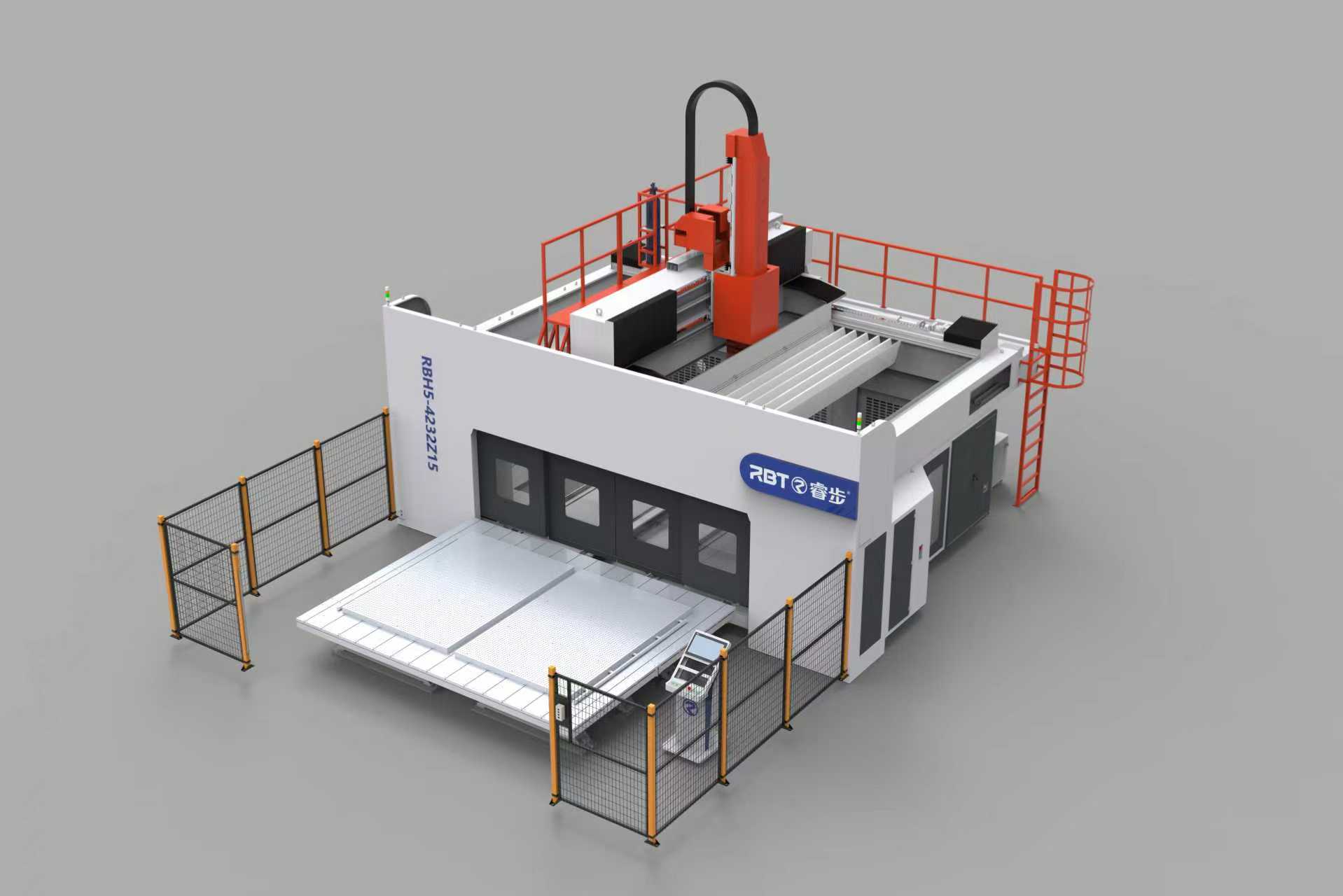
In a 5 Axis CNC Machining Center, the "extra" two axes (usually A and C, or B and C) are where the complexity truly lies. The quality of the mechanical drive systems and the feedback electronics in these rotational axes determines the machine's ability to execute seamless 3D contours.
Precision in the rotational axes is achieved through high-quality gear systems, such as harmonic drives or precision worm gears, that have near-zero backlash. Backlash is the "play" or "gap" between gears; if it exists, the tool will "stutter" every time it changes direction. In a high-quality 5 Axis CNC Machining Center, the rotational axes move with fluid, continuous motion. This is vital when machining complex non-metal molds where the tool must wrap around curved surfaces. Any jerkiness in the rotational motion will leave a "facet" or a flat spot on what should be a smooth, organic curve.
A quality machine is only as good as its feedback system. High-end 5 Axis CNC Machining Center units utilize absolute encoders with millions of pulses per revolution. These encoders provide real-time data to the controller, ensuring that the machine knows exactly where the tool tip is located in 3D space. Lower-quality machines may use incremental encoders that can "lose" steps during rapid movements, leading to positional drift. For a factory producing large-scale wind turbine blade molds or automotive clay models, positional drift is a disaster that can ruin days of work in a single second.
The spindle is the "business end" of the 5 Axis CNC Machining Center. For non-metal materials, the spindle must balance extreme speed with surgical precision.
Because non-metal materials like plastics and resins are sensitive to heat, the spindle must run "cool." Quality spindles utilize ceramic bearings, which have lower friction and better thermal stability than steel bearings. Furthermore, a high-quality 5 Axis CNC Machining Center often features an integrated liquid cooling system for the spindle motor. This prevents the spindle from expanding as it heats up during a long shift. Without this thermal management, the spindle would "grow" in length (thermal drift), causing the tool to cut deeper than intended—a common cause of rejected parts in precision foam and wood routing.
Spindle "run-out" is the deviation of the tool from its true axis of rotation. In a high-quality 5 Axis CNC Machining Center, the run-out is measured in microns. When a tool is spinning at 30,000 RPM, even a tiny amount of run-out causes the tool to "wobble," leading to premature tool wear and a rough surface finish. Quality spindles are dynamically balanced to an extremely high G-rating, ensuring that the cutting action is smooth and quiet. This precision allows for the use of "diamond-coated" tools on abrasive composites like fiberglass without the risk of tool breakage or surface delamination.
The "brain" of a 5 Axis CNC Machining Center is its controller. The quality of the software algorithms that manage 5-axis simultaneous motion is what separates an industrial-grade machine from a basic hobbyist tool.
TCPM is a sophisticated algorithm that allows the machine to track the very tip of the tool as the rotational axes move. In a high-quality 5 Axis CNC Machining Center, TCPM is executed with such high processing speed that the tool glides over complex 3D surfaces without slowing down. This is essential for materials like technical plastics (Acrylic, Polycarbonate), where any "dwelling" or slowing down of the tool would generate friction heat and melt the surface. A quality controller ensures that the surface speed of the tool remains perfectly constant, regardless of the complexity of the geometry.
Modern 5-axis G-code files often contain hundreds of thousands of tiny linear movements to describe a curve. A quality controller has "Look-Ahead" capabilities, meaning it analyzes thousands of blocks of code in advance to calculate the smoothest possible acceleration and deceleration. This prevents the machine from "jerking" at corners. For non-metal materials like high-density tooling board, this smoothness results in a "Class A" surface finish that requires zero manual sanding, drastically reducing the labor costs for the factory.
One of the most overlooked aspects of quality in a 5 Axis CNC Machining Center is how it handles the waste products of non-metal machining. Materials like carbon fiber, fiberglass, and EPS foam produce massive amounts of fine, abrasive dust that can be lethal to a machine’s mechanical and electrical components.
A high-quality machine designed for non-metals features "total sealing." This includes bellows or specialized covers for the linear guides and ball screws to prevent dust from entering the bearing races. Furthermore, quality 5 Axis CNC Machining Center units often have "pressurized" electrical cabinets and spindle heads. By maintaining a slightly higher air pressure inside these components, the machine naturally "pushes" dust away, preventing the short circuits and mechanical grinding that would otherwise destroy a lower-quality machine within months of use in a composite or wood-working shop.
Quality isn't just about the machine's movement; it's about the machine's environment. A premium 5 Axis CNC Machining Center is designed with integrated dust extraction shrouds that follow the tool head. This ensures that 99% of the dust is captured the moment it is created. For materials like carbon fiber, which is electrically conductive, this is not just a matter of quality—it's a matter of safety. A quality dust extraction system prevents the buildup of conductive dust that could cause catastrophic failure in the machine's servo motors or control electronics.
While the initial purchase price of a high-quality 5 Axis CNC Machining Center is higher, the Total Cost of Ownership (TCO) is invariably lower. Quality is a long-term economic strategy that pays for itself through efficiency and reliability.
In many factories, the "hidden cost" is the army of manual laborers required to sand, polish, and repair parts after they leave a low-quality CNC machine. A high-quality 5 Axis CNC Machining Center produces parts that are so accurate and smooth they can go directly to assembly or painting. By eliminating 80% of manual post-processing, the machine effectively pays for its "quality premium" through labor savings alone. In high-stakes industries like aerospace interior manufacturing, this consistency is the key to maintaining thin profit margins.
Non-metal materials, particularly advanced carbon fiber pre-pregs or large blocks of specialized resin, are incredibly expensive. A single error on a large-scale 5-axis part can result in tens of thousands of dollars in wasted material. A high-quality 5 Axis CNC Machining Center provides the "certainty" that the part will be right the first time. The superior volumetric accuracy and thermal stability of a quality machine mean that scrap rates are kept to a minimum, ensuring that the factory’s raw material budget is spent on shippable products rather than waste.
A 5 Axis CNC Machining Center is a 10-to-20-year investment. Quality ensures that the machine remains a competitive asset throughout its entire lifecycle, rather than becoming a maintenance liability.
Quality also extends to the manufacturer’s support ecosystem. A quality machine is built using standardized, high-end components from reputable global suppliers. This ensures that if a sensor or a motor does eventually wear out, a replacement can be sourced quickly. Lower-quality machines often use "no-name" components that are impossible to find five years after the machine is purchased. A 5-axis CNC machining center from Fujian RBT Intelligent Equipment Co., Ltd. – a provider with over 24 years of engineering expertise – ensures that manufacturers have the high-quality parts and comprehensive technical support needed to keep their global production lines running smoothly, no matter where their facilities are located.
The manufacturing world is changing rapidly. Today’s factory might be machining wood, but tomorrow it might be machining carbon fiber for electric vehicles. A high-quality 5 Axis CNC Machining Center has the versatility and the "overhead" in its performance to handle these transitions. Because it is built to the highest standards of precision and speed, it can be re-tasked for new, more demanding materials as the market evolves. This adaptability is the ultimate form of "future-proofing" for any modern manufacturing facility.
In the final analysis, quality in a 5 Axis CNC Machining Center is not a single feature—it is a comprehensive philosophy. It is the synergy of structural mass, high-speed electronic feedback, thermal management, and robust environmental protection. For factories working with non-metal materials, investing in quality is the only way to achieve the precision required by modern design and the efficiency required by modern markets. A high-quality machine does not just cut material; it provides the stability and reliability that allow a business to grow, innovate, and lead its industry with confidence. In the world of 5-axis machining, quality is not just a preference—it is the standard of excellence.


