English
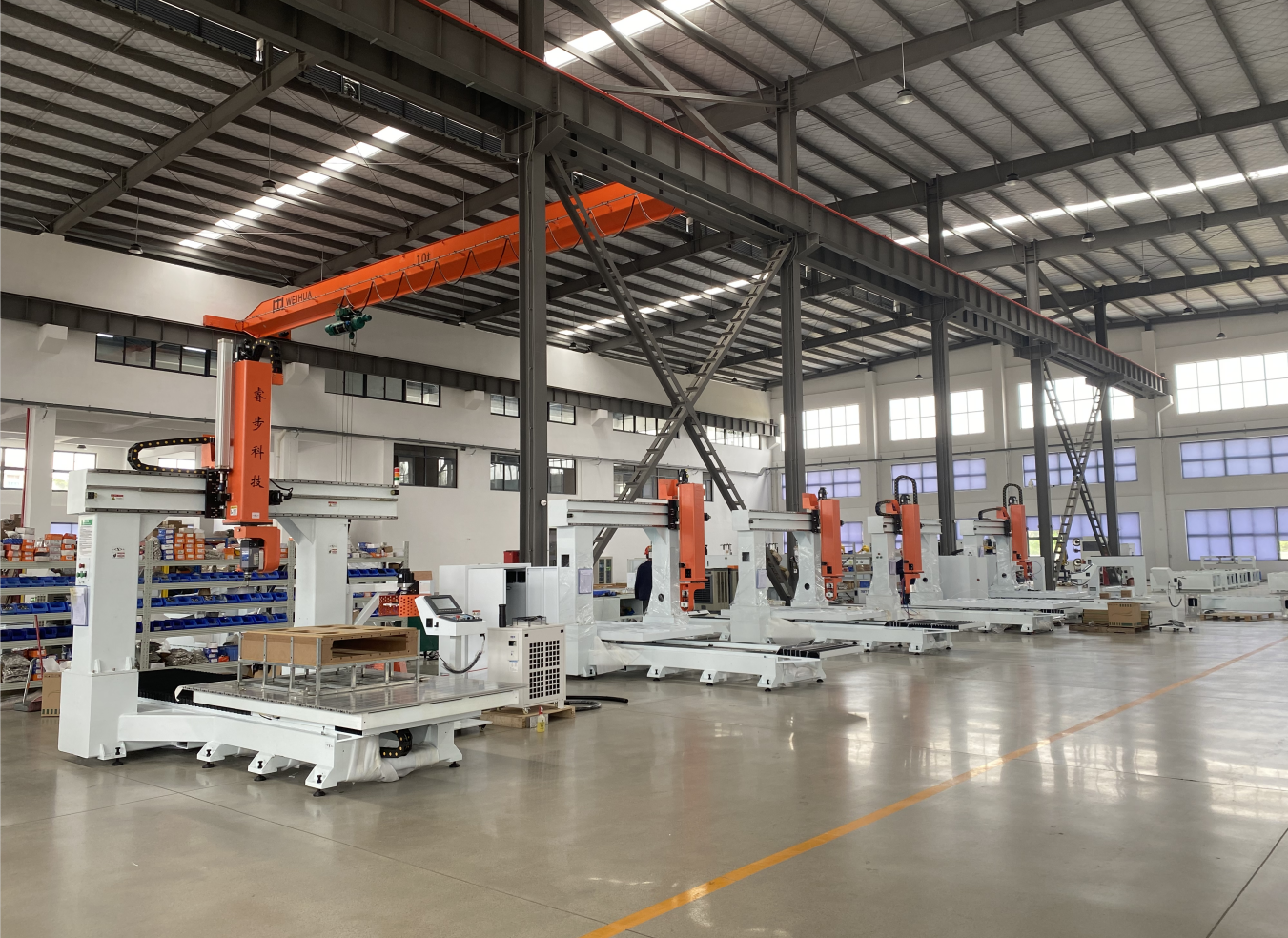
Thermoformed plastic parts often feature complex 3D contours, curved surfaces, and irregular edges that require precise post-forming operations. A 5-axis CNC router enables accurate trimming, drilling, hole cutting, and edge finishing from multiple angles, helping manufacturers achieve consistent part quality and efficient production.
From automotive interior panels and sanitary products to medical housings and industrial plastic components, 5-axis CNC technology offers a flexible solution for machining thermoformed parts with demanding geometries. The right machine configuration, cutting tools, and workholding system are essential for achieving clean edges and reliable machining results.
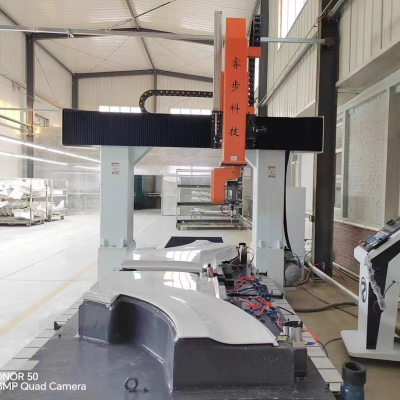
Thermoforming is a manufacturing process in which a plastic sheet is heated and shaped over a mould. After forming, the part usually has excess material around its edges and may require additional openings, slots, holes, or precisely finished contours before assembly.
CNC trimming removes this unwanted material according to a programmed toolpath. Compared with manual trimming, CNC machining can improve repeatability, reduce dependence on operator skill, and help manufacturers maintain consistent part geometry across production batches.
A 5-axis CNC router adds two rotational axes to the three linear axes. This allows the cutting tool to approach the workpiece from different directions, making it useful for parts with angled walls, deep contours, curved surfaces, and complex edge profiles.
Key CNC Machining Processes for Thermoformed Plastic Parts include dge Trimming, 3D Contour Cutting, Hole Cutting and Drilling, Complex Edge Finishing.
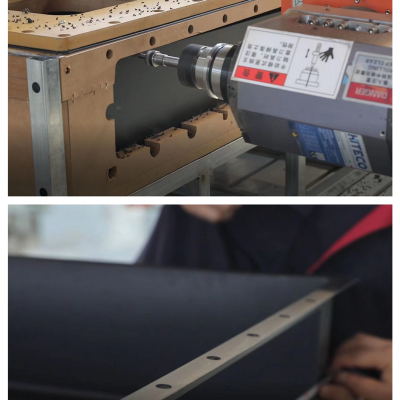
Different plastic materials have different cutting characteristics. Material thickness, rigidity, surface finish requirements, and part geometry should all be considered when selecting the cutting tool and machining parameters.
ABS (Acrylonitrile Butadiene Styrene): Commonly used for automotive interior components, equipment housings, and durable formed panels.
PVC (Polyvinyl Chloride): Used in selected formed panels, enclosures, and industrial products, depending on the material grade and application.
PC (Polycarbonate): Suitable for applications requiring impact resistance and durable formed components.
PET and PETG: Used for formed covers, packaging components, display products, and various transparent or coloured parts.
PP (Polypropylene): Used for lightweight formed components in automotive, packaging, and industrial applications.
PE and HDPE: Used in selected industrial covers, containers, and formed plastic products.
Acrylic (PMMA): Used for display panels, covers, and applications requiring a clear or polished appearance.
The appropriate machining strategy depends on the specific grade, thickness, forming quality, and required edge finish. Cutting trials may be necessary to determine the best tool geometry, spindle speed, feed rate, and workholding method.
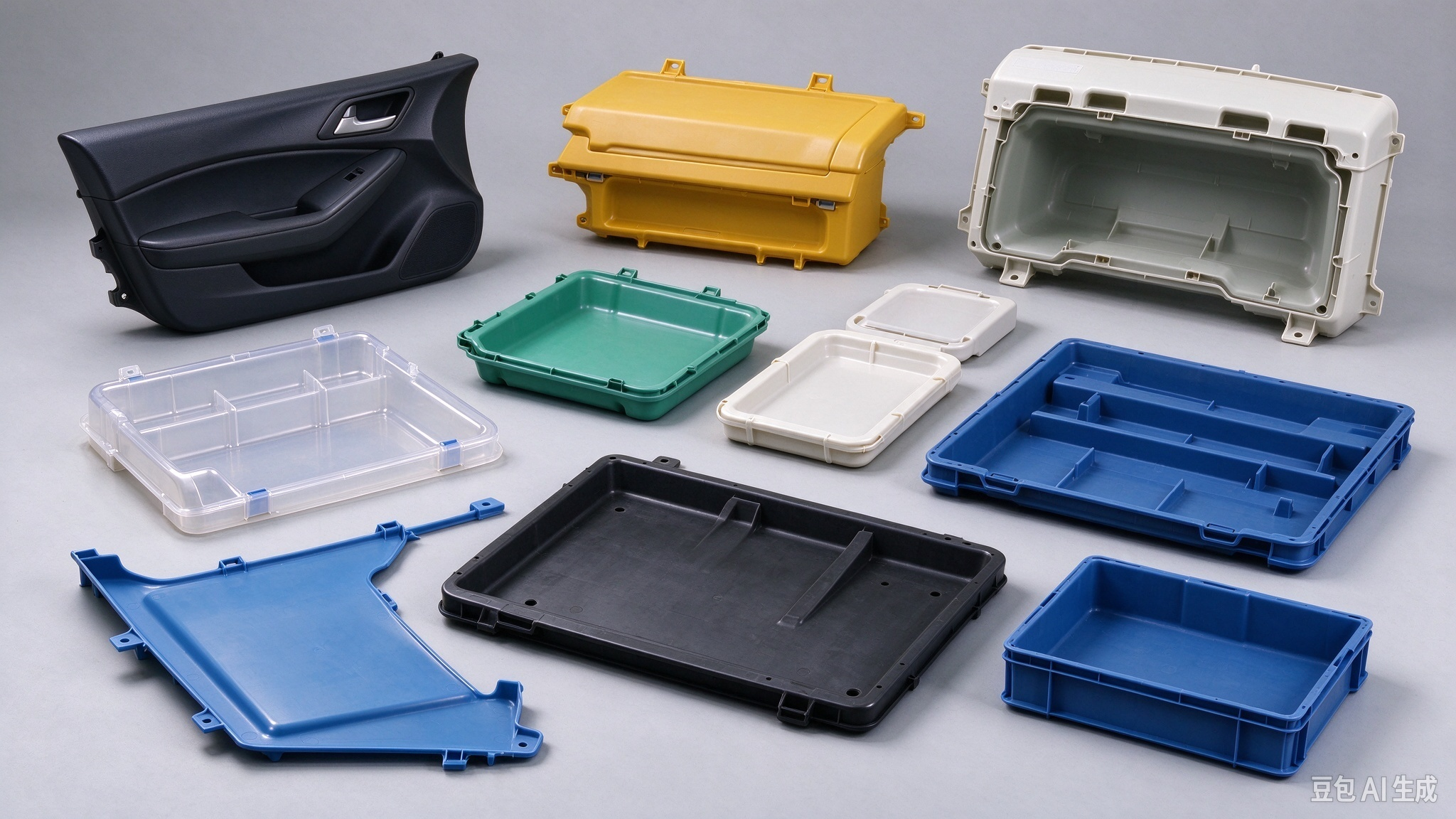
Thermoformed plastics are used in various automotive components, including interior trim panels, protective covers, luggage-area liners, and selected exterior or underbody parts. These components may require complex outlines, cut-outs, mounting holes, and consistent edge quality.
A 5-axis CNC trimming solution can process multiple features on shaped parts while helping reduce repeated manual positioning.
Commercial Aircraft Interior Components
5-axis CNC trimming machines are used to trim and finish thermoformed plastic components for commercial aircraft interiors, including seat back panels, seat shells, and tray tables. They enable precise contour cutting, clean edges, and accurate openings for lightweight interior components.
Formed plastic covers and housings can be found in medical equipment, industrial machinery, electrical enclosures, and protective systems. Depending on the design, machining may include perimeter trimming, access openings, and mounting features.Consistent CNC processing helps manufacturers maintain repeatable dimensions and supports efficient downstream assembly.
The two rotational axes allow the tool to approach the workpiece from different angles. This is especially useful for components with sloped walls, compound curves, and complex edge profiles.
Programmed toolpaths help maintain repeatable cutting paths from part to part. Actual dimensional performance depends on machine condition, calibration, fixtures, tooling, and the part itself.
When the machine can access several faces and angles in one setup, repeated clamping and manual alignment may be reduced. This can simplify production and lower the risk of positioning errors.
Machine working dimensions should match the customer's largest components, including the fixture and tool-access requirements. Large-format parts may require a gantry machine, while higher-volume production may benefit from a twin-table configuration.
With suitable tooling, fixtures, programming, and operator training, CNC trimming can help reduce manual finishing and improve production consistency. Actual cycle-time improvements should be evaluated using the customer's part geometry and production conditions.
Selecting the right machine starts with the parts you need to produce, rather than the machine specifications alone.
Part dimensions: Confirm the maximum length, width, height, and fixture envelope.
Material and thickness: Identify the exact plastic material, sheet thickness, and forming characteristics.
Machining requirements: List all trimming lines, holes, slots, angled cuts, and edge-finish requirements.
Production volume: Consider batch size, loading and unloading time, and whether a twin-table system would be useful.
Workholding: Ensure the formed part is supported securely without damaging or distorting its surface.
Dust extraction and safety: Choose suitable extraction and guarding for the material and cutting process.
Programming and support: Check CAD/CAM compatibility, operator training, maintenance, and technical assistance.
It is used to trim formed plastic parts, cut complex contours, create openings, and machine angled edges. The exact capabilities depend on the machine configuration, tooling, and workpiece geometry.
Many CNC routers can be configured to machine these plastics. The suitable cutting tools and machining parameters depend on the material grade, thickness, part geometry, and required finish. Confirm compatibility with the machine supplier before production.
Not always. A 3-axis machine may be sufficient for parts with simple profiles and accessible cutting paths. A 5-axis machine is more useful when the part has angled walls, complex contours, or features that require different tool orientations.
Yes, provided the working envelope, spindle, tooling, fixtures, and control system suit the parts being produced. Product changes may require different fixtures, toolpaths, and machining parameters.
Useful information includes part drawings or 3D files, material type, thickness, maximum part dimensions, required machining operations, expected production volume, and desired edge quality.
Every thermoformed plastic component has its own shape, material characteristics, and machining requirements. RBT can help you evaluate a suitable 5-axis CNC configuration based on your workpiece dimensions, trimming operations, and production needs.
Send us your request detaisl so we can better understand your application and discuss a suitable machining solution.
Contact RBT to discuss your thermoformed plastic CNC trimming project.